Showing posts with label Seneca Creek. Show all posts

Wednesday, June 13, 2012

Walk 21: Seneca Aqueduct, Washington Slept Here, and Stuart's Great Blunder

Whew! When you hit the Seneca Aqueduct at Riley's Lock on the C&O Canal, get ready for an avalanche of history.

What's left of the Seneca Aqueduct after the September 1971 blew out one of its arches.

To start with, this is the site of the Seneca Quarry which produced much of the sandstone used in the construction of the lower reaches of the C&O Canal. But even before this, quarry work went back to the Revolutionary War period and the cut stone was floated down the Potomac to Great Falls before being shunted onto the Seneca Canal, a forerunner of the C&O, as a bypass to the rapids. George Washington was a frequent overnight visitor to the quarry so you can say "Washington Slept Here."

What the Aqueduct looked like before the 1971 flood.

The stone aqueduct carried the C&O canal over Seneca creek where the now broad and deep creek flows into the Potomac and was maintained by the Riley family for long enough the lock here is named after them.

But more importantly, this is a spot where the Potomac is both broad and shallow, a great place if you wanted to ford it with a wagon.

Which is exactly what Confederate cavalry general J.E.B. Stuart did on June 24th, 1863. Two days earlier, Stuart had been staging a review of his troops at Brandy Station, Virginia, for the local ladies when a Union cavalry force joined the festivities. Stuart's men drove the Union forces back across the river in the largest cavalry battle of the war, but Stuart didn't take kindly to the audacity of the Union gatecrashers.

He requested permission from Confederate commander Robert E. Lee for a retaliatory road into Maryland just as Lee started moving his army across the Potomac. Admonished that the cavalry's main job was to act his "eyes and ears," Lee turned Stuart loose. It was the last time Lee would hear from Stuart before Lee ran head on into the Union Army at a small Pennsylvania town called Gettysburg. No one thing determines the course of a battle, especially not a three day slaughter like Gettysburg, but Lee did go into the battle with little knowledge or where his enemy was. The Union army won the battle and Lee lost his one last big chance to end the war.

Where the heck was Stuart during this time? Well a lot of places because he rode completely around the Union army before rejoining Lee's retreat into Virginia, but after crossing the Potomac at Rowser's Ford, he wasted time wrecking the canal and then marched on Rockville, the county seat of Montgomery County.

J.E.B. Stuart left Lee blind when it counted. The rest, as they say, is history.

Once in Rockville, Stuart captured 125 Union supply wagons and then tried to drive the booty back to Lee. Slowed down by the wagons, he never caught up.

You could probably pick a lot of places where the South lost the Civil War. Rowser's Ford at Riley's lock won't be at the top of the list but it's certainly on the list.

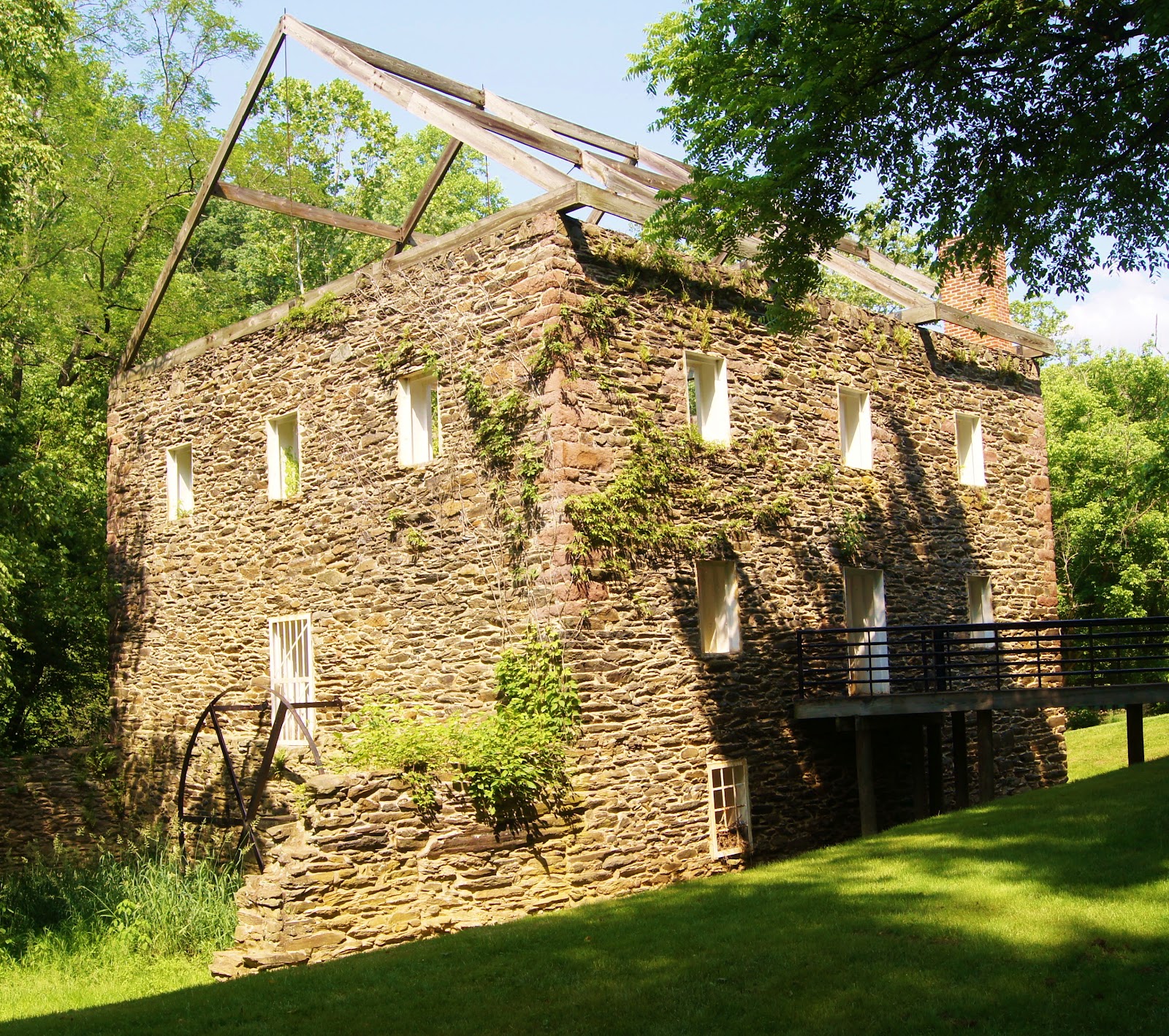
Once you cross the Aqueuct, Loki and I took the first right off the towpath, a dirt road. This leads to the ruins of the Seneca Stonecutting Mill. Powered by water from the canal which was then diverted into Seneca Creek, this mill cut the stone quarried at Seneca Quarry.

What's left of the Seneca Stonecutting Mill.

Stone from this mill wound up building a number of buildings in Washington DC but the most famous is the original Smithsonian Museum, what's colloquially known as the Castle of the Mall.


The Castle


I couldn't find any historic photos of the stonecutting mill but the Library of Congress has these elevation drawings.

Under water power, the mill featured to eight foot band saws that could cut the rock at a rate on one inch per hour. Later, the mill upgraded to a turbine for electricity.

From the ruins of the mill, follow the road up to River Road, a 1 mile walk, that follows Seneca Creek. This is mile one of the Seneca Greenway Trail and if walking on a road sounds a bit unexciting, it is a gravel road and scenic which makes up for it.

 The mile walk to River Road.

When you reach River Road, you will see right across fromn you Poole's General Store. Opened in the mid-1800s, this General Store is the oldest, continuing operating General Store in the County.


Poole's General Store was operated by the AllNutt family for over a hundred years before Poole took it over. 

I wouldn't let this photo fool you too much. The county, with it's million residents, shops pretty much at Target and what not.


 Riley's Lock also serves a base for the Calleva outdoor education camp and here a small campers are being paddled out under the Aqueduct to the broad reaches of the Potomac. The campers were singing so it sounded like they were having a good time.


Other more recent history comes in the form a request by the National Park that fishermen do them a favor by killing any Northern Snakes heads they catch in the canal.


These voracious fish, which are native of China,  were released into a Maryland lake a few years ago. Not only are they eating virtually every other fish in our waterways, but they are spreading because of their ability to walk short distances on land. Maryland, which abolished the death penalty, makes an exception for these fish.


Maybe all the Snakeheads being killed in the area is what is keeping this Black Vulture hanging around.





Saturday, June 9, 2012

Walk 19: Seneca Creek Greenway Trail, Berryville Road Area

The Seneca Creek Greenway Trail, a 14 mile trail that links Clopper Road and the Potomac, is, according to Loki, a trail filled with monsters, such as this box turtle.

Loki rushes the monster before springing back to safety.

Well, okay, so a box turtle doesn't really qualify as a monster but if you are enough of a coward, you can scare yourself silly over just about anything. Which more or less describes Loki. At the first hint of thunder, he's down in the basement in his sleeping crate looking around with a paranoid expression. I've told him a hundred times we don't really get tornadoes but he doesn't believe me. Either that or he figures there is always a first time and our house has a bulls eye on it.

Loki steeled himself to sniff the turtle a couple of times before jumping back as if he were tangling with a 35 pound snapping turtle and then when it did nothing but peer out at him from its shell, he got bored and wandered off.

As a kid, we used to keep box turtles as pets during the summers feeding them tomatoes, ground beef and lettuce and then dropped them off back where we found them in the fall. But the weird thing about box turtles is you can never find them when you go looking for them. You only find them by chance when you are walking in the woods. All very Zen, no doubt.

Loki and I hiked a section of the Seneca Creek Greenway trail from about mile posts 4.5 to 2.5 which links to the two parking areas on Berryville Road. Despite the name, much of this section of the trail meanders through second growth woods with nary a sight of the creek itself. Although most of the trees are less than a foot in diameter, I did spot what a forester once told me was a "wolf tree."

Back when these forests were being clear cut for charcoal and what not, the loggers would periodically leave behind an oak with a full crown because it would help reforest the area with its acorns. This tree must have been 6 to 7 feet in diameter and its crown was nearly a full circle. I don't know enough to date trees by sight, but I would imagine this one probably shaded a few Union troops during the Civil War.

A wolf tree. You can see how much more massive it is compared to all the other trees.


The trail, which follows one of the boundaries of Seneca Creek State Park, also swerved out of the woods and through some abandoned hay fields. This is where we found a whole swathe of native grasses. Among other things, Maryland is trying to restore some of the native plants and the native grasses the settlers found were some of the first things to go. Farmers replaced the tough native grasses with timothy and orchard grass so they could get two cuttings of hay off their fields. Unfortunately, they also wiped out the quail while they were at it because that's a ground nesting bird and the cutting bars went through the nests on the June cutting.


Six foot high native grasses dwarf Loki.


You can always spot the native grasses because they grow higher than six feet, much higher than timothy or orchard. Anyway, I have some hay baling in my background and so far in life, this is the first time it's been even remotely useful to me.

The other point of interest in the walk is that it takes you through some abandoned  hay fields which the forest is slowly reconqueror and just beyond the park boundary are working farms.


 An abandoned hay field overlooking a farm
 

Yep, even with a million residence, Montgomery County still has some rural spots although these are getting squeezed by rising land prices.

By mile three and without a single swim to cool off, Loki was dragging tail for sure. I hadn't really realized what that saying meant, but when he gets hot, he moves slower and slower until he's more or less underfoot on the walk and his tail is about as low as it would go.

Fortunately, that's when we rejoined the creek which at this point is pretty fast moving. Normally, being more or less a chicken, Loki won't tangle with fast water, but when you're hot enough, anything looks good. Or maybe the sun had gotten to him.

Loki finally gets a chance to cool off.

Now, a lot of people I come across on my walks not only are familiar with Border Collies, but they've heard that Border Collies are supposed to be smart dogs. I usually let these comments pass because while Borders may be smart dogs, they are still dogs. And one of the things Loki doesn't quite get about life is gravity.

In his case, he's so overexcited to chase after the tennis ball, he drops it ten feet from me instead of at my feet. Works fine normally, but if that ten feet is on the edge of a stream embankment, gravity takes over and the ball rolls back into the creek. And I'm not about to clamber down some mud bank after it.

I tell Loki "Find the ball!" which means bring it back up for another try, why don't you. He can do this six or seven times before he figures out he has to drop the ball on level ground.

As I say, Borders might be smart, but they're still just dogs.

Practical information: Drive out River Road towards Poolesville and take a left on Seneca Road and left on Berryville Road. There are two parking areas at roughly mile posts 2.5 and 4.5. One way is two miles round trip about 4 miles.

Tuesday, May 29, 2012

Walk 10: Seneca Creek's Schaeffer Farm

Well, I didn't much care for the walk at the lake in  Seneca Creek State Park (see Walk 10), but the Schaeffer Farm section of the park more than makes up for it.

A carpet of ferns along the White Trail.

The Schaeffer Farm trails have no names other than a color and we picked the White Trail, a four mile loop that skirts around an abandoned farm. The other trails include, green, yellow, red and blue. All the trails link up one way or another so there are miles of variations involved.

We parked at the Black Rock Mill on Seneca creek and crossed the one-lane bridge to the foot of the bluffs on the other side. There are two ways up the bluff from here. The first is an informal trail that heads more of less straight up and your heart will be pounding when you reach the top.

Black Rock Mill ground wheat into flour for most of the 1800s. After that, wheat production in the country headed west and mill went bust.

The second is the Seneca Ridge Trail, marked with red blazes, that switch backs to the top. Either way, the short, sharp climb means most walkers pass up these woods, which is a mistake.


Once on top of the bluff, the White Trail loops around both abandoned and working farm fields with occasional sections out in the sun. With August temperatures already here in May, this was a one hot walk.


Black Rock Mill back around 1900.

We stopped at the one stream that cuts through the bluffs to give Loki a cool down which he much appreciated. 

While the trails are clearly marked, there is not much information about them available and we passed near a property called Button Farm. When we walked down the lane to it, I couldn't really tell if it was a working farm or an abandoned one and not wishing to trespass, we took a photo and left.


This is how the county looked before urbanization took up much of the farms.

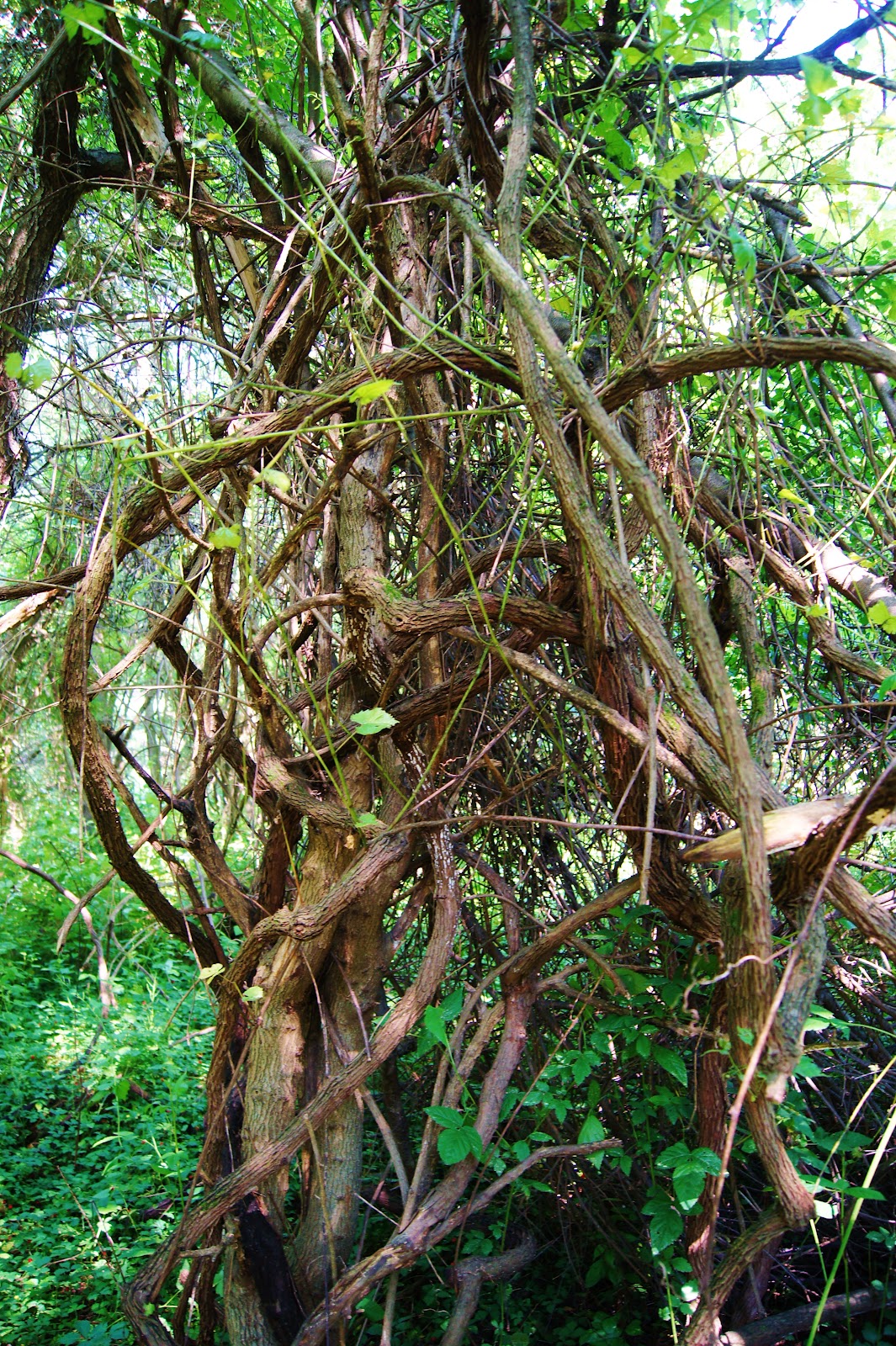
For the first time on our walks, we also passed by a signature plant for the area which are the huge vines that strangle the hardwoods. These vines wouldn't look out of place in the Amazon and you can climb them if the branches they are attached to can bear the weight. The downside is if they can't, the branch comes straight down which can be a problem.


Tarzan would be proud of our vines.

While the trail keeps to the cooler woods, which was much appreciated, we did see an abandoned hay field that is slowly turning back into woods. Several smaller trees such as Sycamores are already colonizing the field. Actually, I've heard that aerial surveys show that is happening all  up and down the East Coast as the small family farms go out of business. The amount of forest cover we have is up sharply from what was left in 1900.


In another hundred years, this will all  be forest once again.

Just before we hit Seneca Creek, Loki decided he had had about as much of the heat as he was going to take and found what has to be the deepest mud wallow I've seen in a long time.


Up to his chest in ripe smelling swamp mud. The next stop for Loki was a dip in Seneca Creek to wash off.


Practical information: Take Darnestown road towards Frederick and turn right on Black Rock Road. You can park by Black Rock Mill or on the side of the road across the one lane bridge. Pick up Seneca Ridge trail and climb the bluff. The White Trail is about 4 miles and is hilly. After wet weather, expect mud. Trail rating is 3 out of 3 stars. Never crowded.